VMware Costs Rising: Time to Look at Proxmox
VMware Costs Rising: Time to Look at Proxmox
The shift from VMware to open-source alternatives is no longer just a budget discussion... With the new Proxmox updates, switching to open-source has become a serious strategy for enterprise infrastructure. Broadcom's changes to VMware licensing are hitting hard, and many organizations are actively looking for a way out.
Perpetual licenses are a thing of the past, and the retired Essentials Plus Kit means small and medium IT teams are feeling the pain. As companies face massive cost increases, open-source options like Proxmox are stepping up to fill the gap. Keep reading to learn why this shift matters and how to plan a safe migration.
Contact our Proxmox Knowledge Sharing Center
Main section
Quick facts
/
Proxmox has become a serious strategy for enterprise infrastructure
/
Organizations face an estimated 63% cost increase over a seven-year hardware cycle with new VMware models.
/
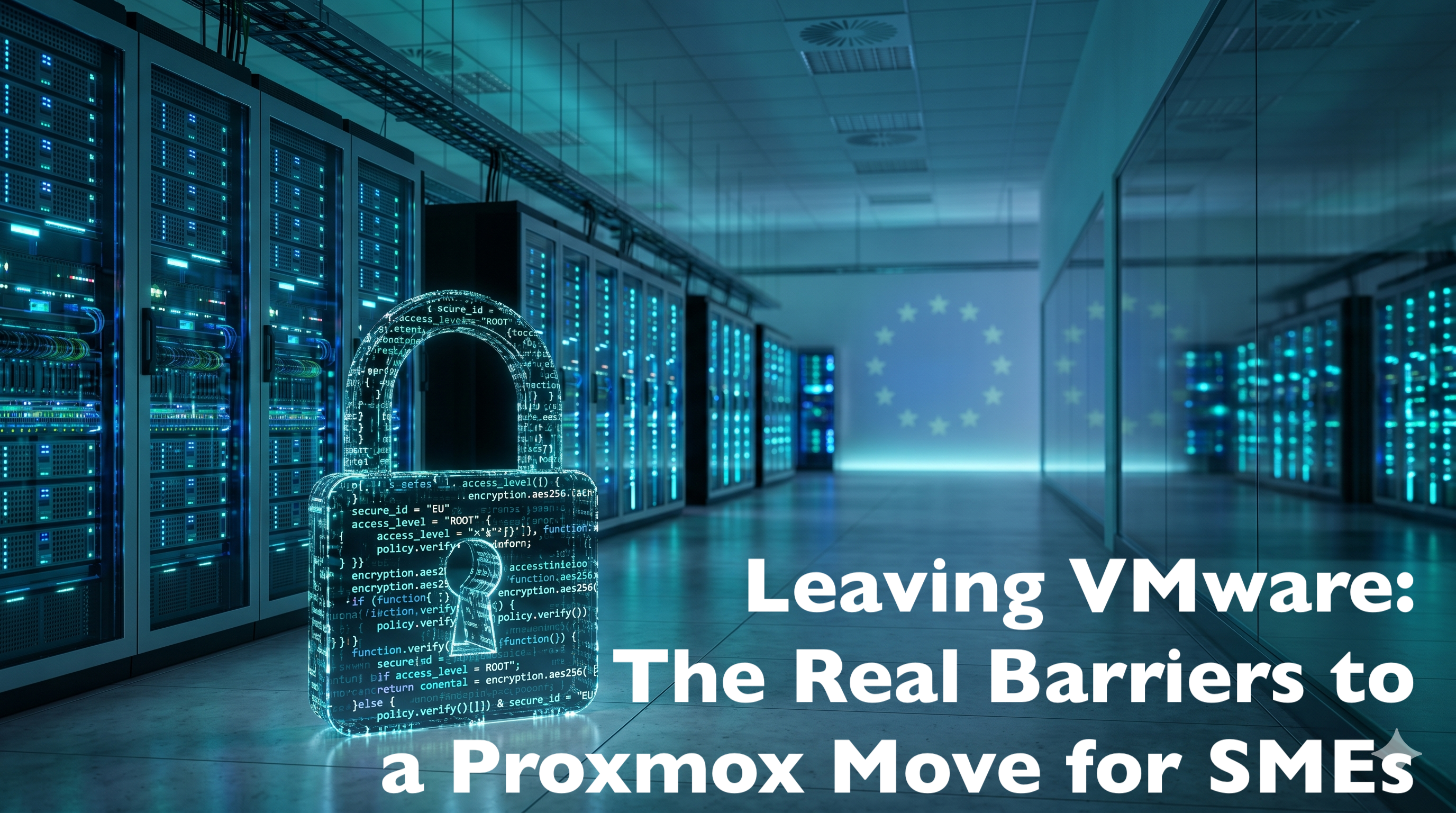
Proxmox is based in Austria, supporting EU digital sovereignty.
/
Perpetual licenses are a thing of the past
The Open-Source Alternative and Why It Matters
Broadcom's new strategy for VMware has removed the basic models that many IT teams relied on for years. Organizations are now looking at an estimated 63% cost increase over a typical seven-year hardware cycle. Sources: NovaCloud and Synoptek.
At the same time, the open-source community is delivering powerful new tools.
Proxmox Virtual Environment 9.2 was just released, and it introduces a Dynamic Load Balancer that automatically moves workloads to keep your cluster healthy. It also adds native WireGuard and BGP (Border Gateway Protocol) to its software-defined network stack. Proxmox Backup Server 4.2 also launched recently, making the entire ecosystem even stronger.
Consider the car analogy. Think of your IT infrastructure like leasing a company car. For years, you had a reliable partner with fair terms. Suddenly, a new owner takes over the dealership, forces you into an expensive subscription, and removes the basic models you relied on. You can either pay the premium or find a new dealer.
Around 98% of VMware users are already using, planning to use or considering alternatives for at least a part of their VMware estate (source: StockTitan/RMNI Survey), so you are definitely not alone.
There is also a growing discussion about EU digital sovereignty - keeping our data and software control within Europe. While cost and features are the main reasons people leave VMware, moving to an open-source solution like Proxmox gives you more independence from big US tech companies. Proxmox is based in Austria, which is a very nice bonus for European companies wanting more control over their own systems and data.
Proxmox is acting as that new "car dealer" for many companies today but switching to this new dealer takes careful planning.
If you are preparing a migration, here are a few practical tips to keep in mind (source: Petronella Tech's "Migrate VMware ESXi to Proxmox VE: 2026 Step-by-Step" article):
- Test the waters: Start your migration with development and test machines. Build your confidence before touching critical production systems.
- Check your network speed: Moving a 500 GB virtual machine takes about 90 minutes over a standard 1 GbE connection. Calculate your time before you schedule a maintenance window.
- Map your network: VMware and Proxmox handle networking differently. Map out your VLANs and IP addresses early.
- Use the import wizard: Proxmox has a built-in import tool that can pull data directly from VMware while the original machine is still running.
Bottom section
Learn More and Join the Discussion
Leaving VMware entirely has its pros and cons. Yes, you can cut costs, gain flexibility, and remove yourself from Broadcom’s licensing structure. But you will need to retrain teams, rebuild parts of your infrastructure, and absorb some risk during the transition.
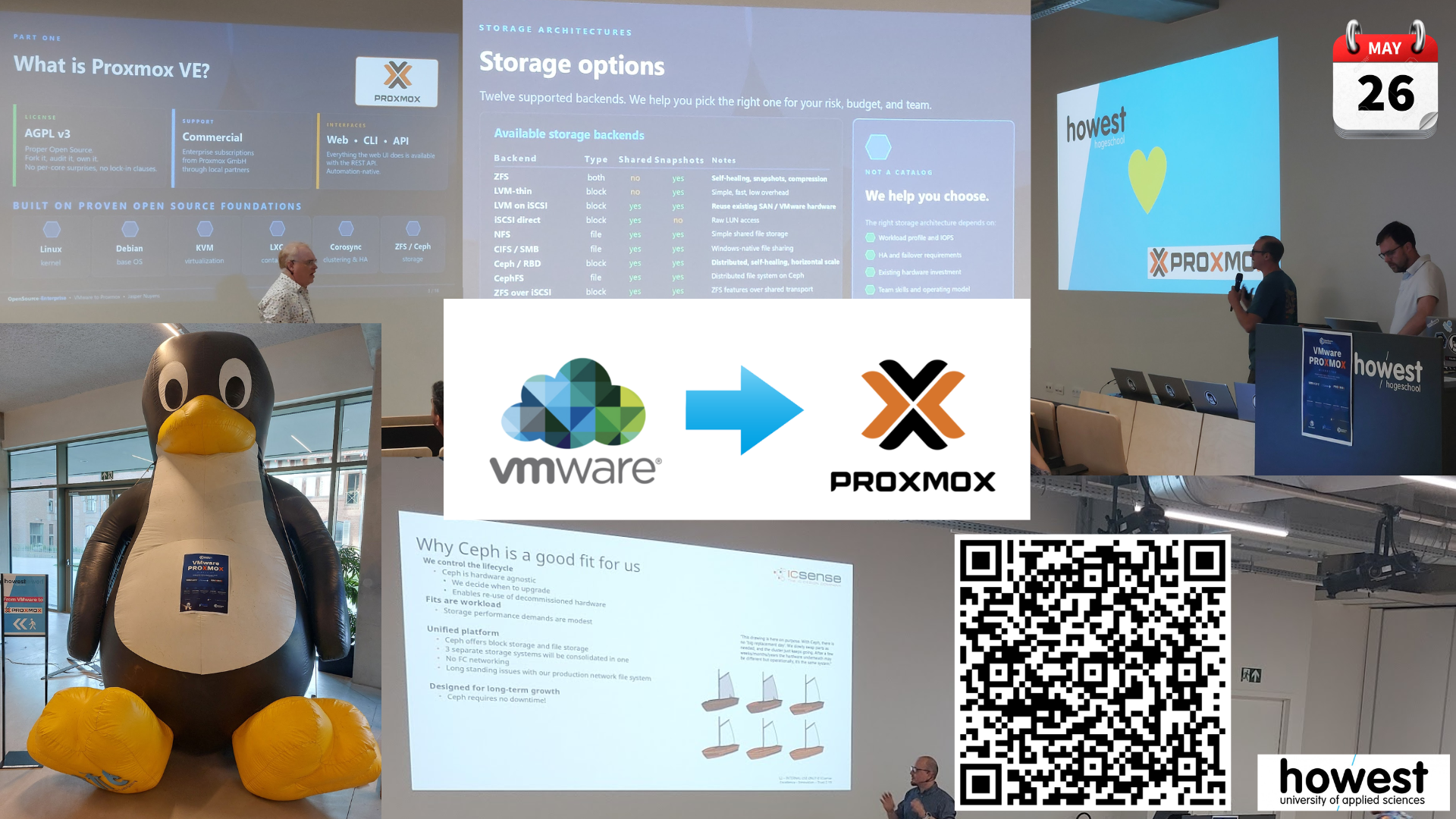
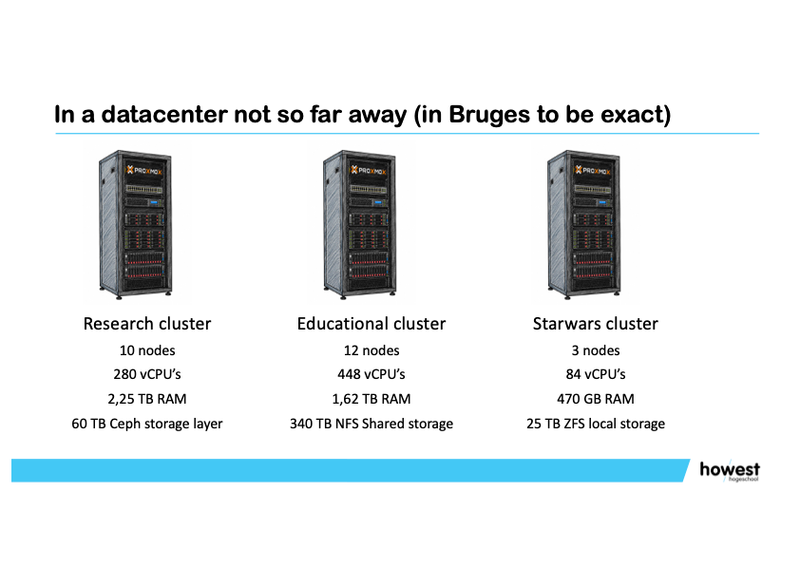
At Howest University of Applied Sciences, we teach Proxmox to our students, and it is a cornerstone of our educational infrastructure. We now want to share that practical knowledge with companies that want to know more about Proxmox. We are e.g. looking for internship opportunities and small projects for our growing number of students. Contact us for more info on this.
Later this year, we will start a Proxmox Knowledge Sharing Center, offering independent information and training built on our practical skills in systems and network management, cybersecurity, virtualisation, enterprise infrastructure, Linux and Proxmox. If you want to know more about Howest's Proxmox Knowledge Sharing Center, please fill in the form and we will contact you with more info.
Of course, we will be using this:
Finally, we also work together with the first Belgian Official Proxmox Partner OpenSource-Enterprise, a joint initiative by Linux Belgium and Mind OSS, focused on bringing structured support, education and consultancy for open source software into the enterprise market. They offer infrastructure assessments, migration, proof-of-concepts, support, maintenance, ... to governments and enterprises.
To stay up to date about the latest developments in the virtualization market, we recommend these specific resources:
1. Official Proxmox Channels
- Proxmox Press Releases: there is the official Proxmox website for the exact release dates and technical specifications. This is where you will find more about Proxmox VE 9.2 (released May 21, 2026), the Dynamic Load Balancer, and Proxmox Backup Server 4.2.
- Proxmox Documentation and Release Notes: these are the official Proxmox VE documentation where you can read how the new native WireGuard and BGP support actually works within their Software-Defined Network (SDN) stack.
- The Proxmox Community Forums are a great place to see how administrators are reacting to new features and what migration challenges they are currently facing.
2. Virtualization and IT Infrastructure Blogs
- The vInfrastructure Blog run by IT veteran Andrea Mauro is a great resource for hands-on virtualization, cloud, and enterprise storage news
- Virtualization Review: This is one of the most comprehensive independent sources. It covers everything from broad enterprise trends to specific technical benchmarking, making it great for seeing the bigger picture.
- Virtualization Howto: This is a favorite among system administrators. It is highly practical and often features step-by-step guides, home lab setups, and direct comparisons between VMware and Proxmox.
- Yellow Bricks: Run by Duncan Epping, a Chief Technologist at VMware, this blog is deeply technical and focuses heavily on VMware vSAN and high availability. Even if you are moving away from VMware, his architectural insights are incredibly valuable.
- William Lam's Blog: William is another well-known VMware expert who shares highly technical scripts, automation tips, and workarounds.
3. Also Interesting:
- Proxmox vs ESXi 2025: VMware’s Role in Home Lab Virtualization
- Proxmox Tips I Wish I Knew Before Building My First Home Lab
- Getting Started with Proxmox: a Beginner's Guide to Building a Budget Home Lab
- A Beginners Guide to PROXMOX
- Proxmox Storage Types Compared: LVM, ZFS, Ceph, NFS, and iSCSI
- Market Analysis: The current state of IT leaders’ sentiment and planned response to the effects of Broadcom’s acquisition of VMware was analysed in CloudBolt's reality report "VMware Acquisition Aftermath"
- A free 300+ page e-book for Proxmox home lab users, that covers everything from installation, configuration, storage, networking, SDN, and other useful tips.
Contributors
Authors
/
Patrick Van Renterghem, Community Builder @Cyber3Lab (AI + CyberSecurity + Web3 + Immersive Tech)
Want to know more about our team?
Visit the team page
Last updated on: 5/29/2026
/