
Textile Digital Product Passport: A Practical Roadmap for Brands and Suppliers
Textile Digital Product Passport: A Practical Roadmap for Brands and Suppliers
In May 2026, the European Commission's research service (the JRC) published a study on what a Digital Product Passport (DPP) should contain for textile and apparel products. The study is not law yet. It is a preparatory document that points to where the rules are heading under the EU's Ecodesign for Sustainable Products Regulation (ESPR).
For anyone working on traceability and DPP use cases, this matters. The DPP is one of the largest real-world data and verification projects coming to the EU market. It will require trusted product data, supplier evidence and access rules that work across a long and often opaque supply chain.
Get in Touch with our DPP Experts

Main section
Quick facts
/
Study on DPP content for textile apparel products under ESPR
/
Published by European Commission Product Bureau (JRC) on May 13th, 2026
/
This is a preparatory study, not final law
/
Over 90%+ of EU textile supply chain companies are SMEs
Why textile DPP is a data problem, not a QR code problem
It is tempting to think of a Digital Product Passport as a QR code stitched into a care label. It is not. The QR code is only the door. Behind it sits a structured, machine-readable record of product data: fibre composition, durability, recyclability, recycled content, substances of concern, producer information and more. (source: Circularise)
The hard part is getting that data and proving it is correct. The “Study on DPP content for textile apparel products under ESPR”, dated 13 May 2026, gives apparel brands, EU importers and textile exporters an early operational roadmap for DPP readiness. The study should not be treated only as a regulatory document; it should be used to prepare supplier data, product identifiers, access rights, verification workflows and tiered supply-chain visibility before the textile delegated act becomes legally binding.
Easier said than done of course. The study explains that brands usually know their Tier 1 factory, which is the final assembly site. Far fewer can trace the full story behind the fabric (Tier 2), the yarn (Tier 3) and the raw fibre or chemical inputs (Tier 4). Upstream suppliers often keep this data in unstructured files and treat it as confidential.
Solvira, a German company that helps textile exporters, EU importers and apparel brands translate the emerging DPP framework into supplier data maps, readiness audits and phased implementation plans, wrote an analysis of this JRC study at "The May 2026 Textile DPP Study: A Phased DPP Readiness Roadmap for Apparel Brands, Importers and Tiered Supply Chains". Here is their view on the different supplier tiers, and the 6 practical steps to get the information:
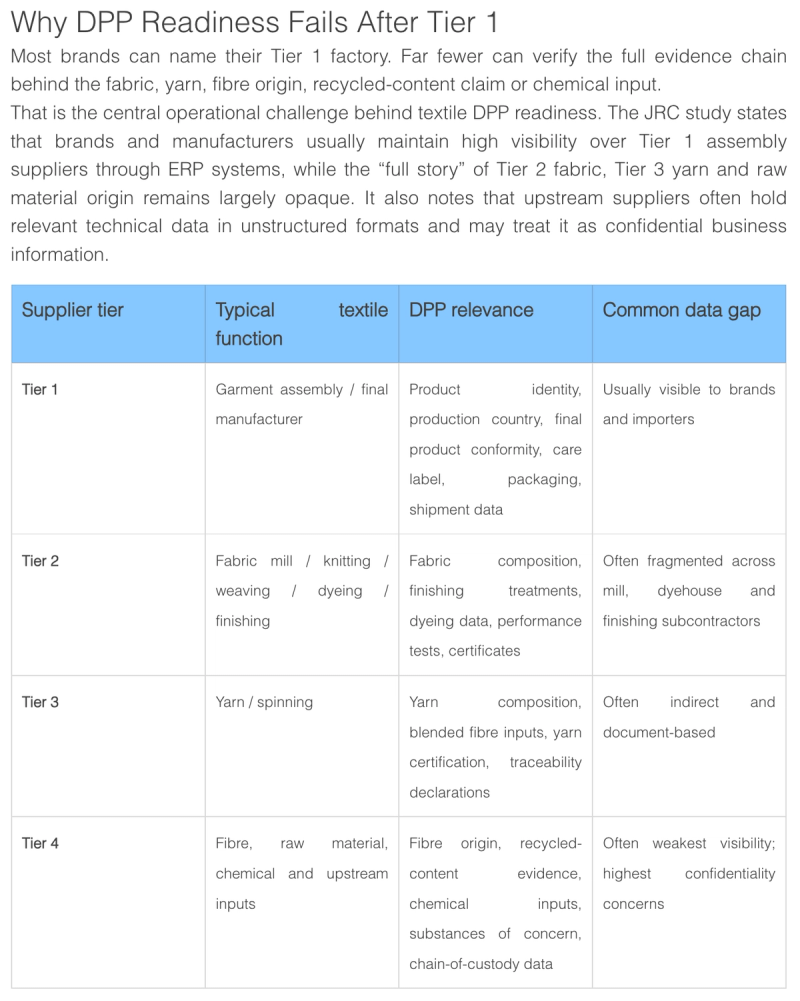
It also separates two ideas that are easy to mix up. Supplier tiers tell you where the data comes from. Granularity tells you at what level the data is stored, at model level, batch level or item level. For most apparel firms, model level is the place to start, with batch level added where testing or sourcing changes from one production run to the next.
To deal with this, the study sets out 6 practical phases: monitor the rules, map which products are in scope, take stock of the data you already hold, trace the missing supplier data across tiers, design who can see which data, and run a pilot on one product family before scaling up. To deal with this, the study sets out 6 practical phases: monitor the rules, map which products are in scope, take stock of the data you already hold, trace the missing supplier data across tiers, design who can see which data, and run a pilot on one product family before scaling up.
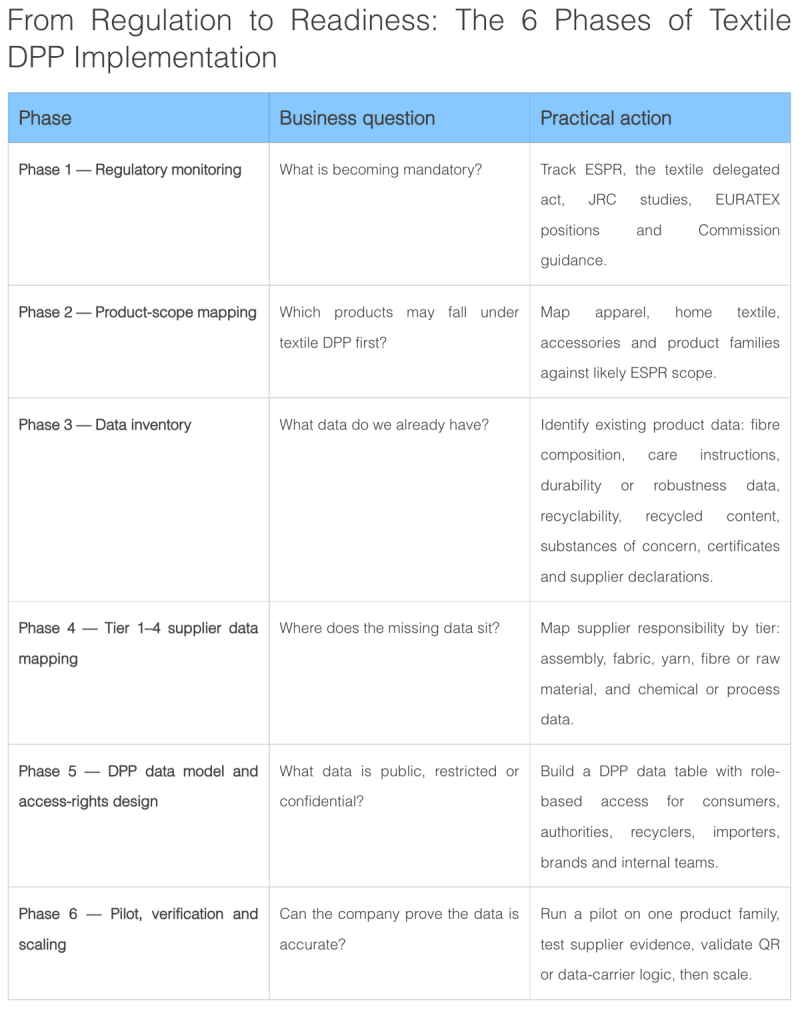
Further analysis of the impact on e.g. supply-chain responsibility and granularity (the model vs batch vs item dilemma) can be found in the Solvira article.
Bottom section
Background information and links:
The Textile DPP shows what trusted product data at scale really demands: unique identifiers, data carriers, access rights, verification and interoperable standards. CEN-CENELEC technical committees are already working on the horizontal standards for these building blocks. This is exactly the space where our research group Cyber3Lab can add real value, by making supplier claims checkable and tamper-resistant.
The takeaway for brands, importers and exporters is simple. Do not wait for the final rules. Start with a readiness check now: map your priority products, find your Tier 1 to Tier 4 suppliers, sort your data into public, restricted and confidential, and pilot one product family. The companies that prepare early will not only comply faster. They will gain better supplier control and stronger buyer trust.
Here are some of the better pointers to background information and resources:
- The JRC Study European Commission Product Bureau "Study on DPP content for textile apparel products under ESPR"
- Regulation (EU) 2024/1781 of the European Parliament and of the Council of 13 June 2024 establishing a framework for the setting of ecodesign requirements for sustainable products
Regulation (EU) 2024/1781 of the European Parliament and of the Council of 13 June 2024 establishing a framework for the setting of ecodesign requirements for sustainable products" - The Euratex Position Paper "The Digital Product Passport for Apparel: Ensuring competitiveness, circularity, and data sovereignty in the European textile sector" (March 2026)
Together with Thomas More and Masjien, the Howest University of Applied Sciences research group Cyber3Lab translate the DPP, ESPR, ecodesign and transparent data requirements to Flemish SMEs via the project DPP InZicht, sponsored by Vlaio. More info at DPP-InZicht.be.
Contributors
Authors
/
Patrick Van Renterghem, Community Builder @Cyber3Lab (AI + CyberSecurity + Web3 + Immersive Tech)
Want to know more about our team?
Visit the team page
Last updated on: 6/24/2026
/